

BuyHome.ge
+995 595 33 78 33


Shared Rather Than Individual Metering: Questions About Utility Billing
Shared Rather Than Individual Metering: Questions About Utility Billing
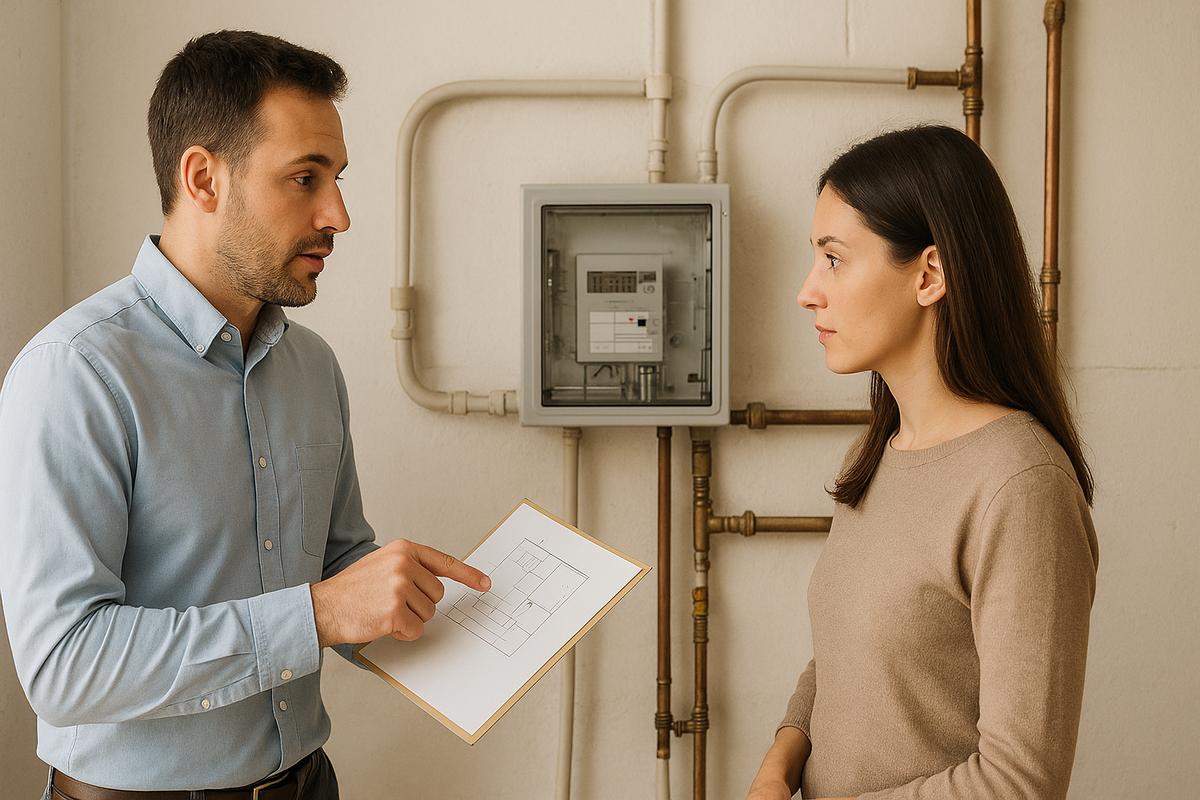
A listing promises modest utility bills, but at the viewing you discover that the apartment has no separate customer account: a manager calculates the payment. Before buying, establish how that calculation works. “Shared meter” alone does not explain who supplies the utility, how your share is determined or which records support the charge.
The essential check is a traceable chain from the supplier’s invoice to the amount allocated to the apartment. An internal meter and a separate supply agreement are different things. A shared arrangement is not automatically unlawful; its suitability for the particular property needs checking.
🔎 Establish what “shared metering” means
Several arrangements can sit behind the same description. A building may have one billing meter and internal meters for individual units. Another building may allocate consumption using an agreed formula without apartment readings. Sometimes each apartment has its own account and only common-area electricity is shared.
Ask about electricity, water and any communal heating separately. An explanation about water does not establish the electricity arrangement. Find out whether the meter covers the whole building, one block, commercial units or a particular group of apartments.
A display beside the front door does not prove independent customer status. Identify the meter, the area it measures, who maintains it and who accepts its readings for billing.
Map the billing chain
Write down four stages:
- The supplier invoices its contractual customer.
- A main meter records consumption for a defined group of premises.
- A manager or another authorised party allocates consumption and costs.
- The owner receives a charge for the individual unit.
For each stage, identify the parties, supporting agreement and billing period. Ask who holds the supply contract, who receives your money and who handles calculation errors. These may be different organisations.
Define the boundaries too: are lifts, pumps, lighting and commercial premises included? Without that information, comparing your internal reading with the building invoice will explain very little.
Documents to request before buying
| Record | What it should establish |
|---|---|
| Supply agreement and customer details | The property and customer receiving the invoice |
| Management agreement and appendices | Authority to allocate and collect payments |
| Written allocation formula | Calculation base, coefficients and exceptions |
| Supplier invoice for a selected period | Consumption, cost, adjustments and separate services |
| Internal reading summary with unnecessary personal details removed | Matching dates and coverage |
| Calculation for your apartment | The origin of each charge |
| Error-reporting procedure | Contact, supporting evidence and correction process |
You do not initially need the building’s entire billing history. Request one complete ordinary period and another with a noticeable variation. Access to summary figures should avoid revealing other owners’ bank details or unnecessary personal information.
🧮 A worked example with explicit assumptions
This is an entirely hypothetical illustration, not a current Georgian tariff or a recommended allocation method.
Assume the building uses 1,000 kWh in one period and the total utility cost is GEL 300. The model has no tiered tariff, fixed charges, arrears or adjustments. Internal apartment meters total 900 kWh. The remaining 100 kWh is assumed to represent common consumption and is divided equally between ten apartments under an agreement verified for this example.
Your apartment uses 90 kWh:
- Personal consumption: 90 × GEL 0.30 = GEL 27.
- Common consumption share: 100 ÷ 10 = 10 kWh.
- Cost of that share: 10 × GEL 0.30 = GEL 3.
- Total utility allocation: GEL 30.
The building-wide check is 900 × 0.30 + 100 × 0.30 = GEL 300. The allocations reconcile with the supplier’s invoice within this simplified model.
For a real invoice, dividing cost by consumption does not automatically establish the tariff applicable to your apartment. Tariff structure, services, adjustments and the allocation basis need separate examination. Any administration charge should be explained separately rather than concealed within recorded consumption.
A difference in readings is not proof of losses
A gap between the main meter and internal meters calls for checks of reading dates, connected premises, common equipment and earlier corrections. Do not immediately label the entire remainder technical losses or a neighbour’s consumption.
Ask whether all readings cover the same interval, how vacant units are treated and what happens when one reading is missing. Establish who investigates an unusual discrepancy and how the outcome appears in later calculations.
“That is what we always get” does not help you estimate ownership costs. You need a repeatable formula and access to its input figures.
Examine the allocation rules
Does the share depend on floor area, unit count, readings or another basis? Ask who can approve a change and how owners are notified.
Commercial users, developer-owned apartments, unoccupied units and overdue payments need specific attention. Another party’s arrears should not disappear into an unexplained consumption line: establish their legal basis and accounting treatment separately.
Also ask who owns the internal meters, how replacements are documented and who can access historical records. These details matter particularly if you expect to manage the apartment remotely.
Can you obtain individual metering?
A seller’s promise that you can “get your own meter later” is not a completed solution. Registering a separate customer, making a technical connection and installing an internal meter can be different processes.
Georgia has electricity application procedures for separating a subscriber and arranging a metering point. Ask the relevant operator whether the procedure applies to this unit, which documents and technical conditions are required and what it costs. Check other utilities separately.
Before purchase, obtain a written response for the actual property and a specialist’s assessment of any works. Do not assume an unknown cost or a guaranteed completion date.
📝 Handling a disputed charge
Record the billing period, meter, apartment allocation and precise discrepancy. Write to the party that prepared the internal calculation, requesting the original invoice, formula and explanation of the disputed component.
If the issue concerns the main billing meter, supply or the supplier’s official invoice, establish the supplier’s or operator’s procedure. An internal management dispute and a utility-service complaint may follow different routes.
Retain the request, response and corrected calculation. Do not assume that making a complaint automatically suspends payment deadlines or removes late-payment consequences. Check the treatment of disputed and undisputed amounts against the agreement and applicable rules.
Pre-purchase checklist
- The contractual customer and payment recipient are identified.
- Main and internal metering boundaries are clear.
- The allocation formula is available in writing.
- You can reproduce one complete period’s calculation.
- Common costs, service charges and corrections are separated.
- Data access and an error-correction process are established.
- Separate metering has been confirmed if it is essential to your purchase.
Frequently asked questions
Does shared metering make an apartment unsuitable to buy?
There is no universal conclusion from this feature alone. Consider the property’s legal and technical arrangement, billing transparency and your requirements.
Does a meter inside the apartment mean a separate account?
Not necessarily. It may only be an internal device used to allocate a building-wide bill. Check the supply agreement and customer registration.
Is the seller’s payment receipt enough?
It provides an example amount but does not establish the formula. Request the supporting calculation for the same period and identify included services.
Does an empty apartment pay nothing?
That depends on the applicable arrangement and components of the charge. Personal consumption and participation in common costs should be considered separately.
Use the findings in your property search
A transparent calculation lets you compare ownership costs on a consistent basis. If supporting records are unavailable, list this as an unresolved purchase condition.
Legal and technical information checked on 31 October 2026; application to an individual property requires confirmation.
Explore the BuyHome property catalogue. Tell us whether independent utility accounts and remote management matter to you so these questions can be included from the beginning.
Date added: 07.11.26
Related articles






Related categories

How to choose a complex
How to choose a residential complex in Georgia — key criteria affecting comfort, liquidity, and investment returns, with common mistakes explained.

How to complete a deal
How to complete a real estate purchase in Georgia — step-by-step breakdown of the process, documents, timelines, and common buyer mistakes.

Bank account opening
How to open a bank account in Georgia — requirements for foreigners, required documents, timelines, and key banking specifics.

Utilities guide
Utility bills in Georgia — overview of electricity, water, gas, internet, and building maintenance costs, with payment methods and expense calculations.
Benefits of buying property on BuyHome.ge

Best property prices
No commission for buyers
Up-to-Date Properties on the Website
Free property selection
Free transaction support
Free expert consultations

Submit a Request
for a Consultation!

2026 © All rights reserved