

BuyHome.ge
+995 595 33 78 33


How to Check Property by Cadastral Code in Georgia: Step-by-Step Guide
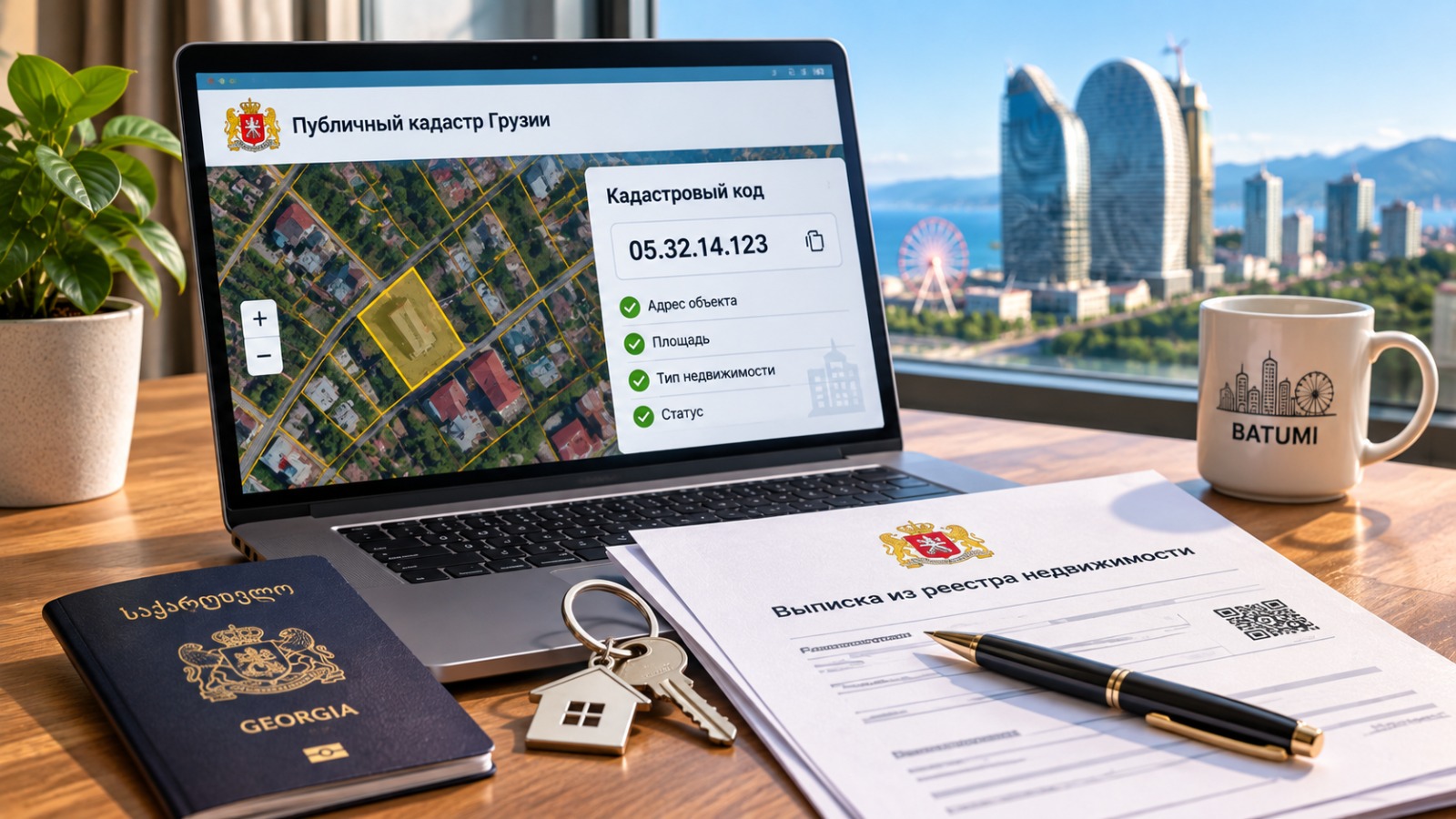
How to Check Property by Cadastral Code in Georgia: Step-by-Step Guide
Buying real estate in Georgia begins not only with choosing an apartment, house, or land plot, but also with verifying the property's legal documents. One of the most important tools for this process is the property cadastral code, which allows you to identify a property in Georgia's official public registry.
Using a cadastral code, you can find information about a registered property, verify its owner, check its area, and identify registered mortgages or other restrictions. This is especially important for foreign buyers purchasing real estate in Batumi, Tbilisi, and other cities in Georgia.
In this guide, we explain how to check property by cadastral code in Georgia, where to obtain an official property registry extract, and what details to verify before completing a real estate transaction.
What Is a Property Cadastral Code in Georgia?
A cadastral code is a unique identifier assigned to a property within Georgia's official cadastral registration system.
It is used to identify land plots, buildings, and individually registered premises, including apartments and commercial properties.
The cadastral code connects a specific property to information maintained by the National Agency of Public Registry of Georgia (NAPR).
When checking an apartment, the cadastral code helps establish which property is registered, who holds the registered ownership rights, and whether any legal restrictions appear in the public registry.
Important: A cadastral code alone does not guarantee that a property is legally clear. A proper verification requires reviewing a current public registry extract and, where necessary, additional documents.
Where to Find the Cadastral Code of an Apartment or House
There are several ways to obtain a property's cadastral code:
- Public registry extract. One of the main official documents containing information about registered real estate.
- Sale and purchase agreement. The cadastral code is normally included to identify the property involved in the transaction.
- Ownership documents. The code may appear in documents confirming the registration of ownership rights.
- Georgia's cadastral map. Information about certain properties can be found using their location on the map.
- Seller or developer. Before purchasing, you can request the cadastral code and current registration documents.
If the seller cannot provide a cadastral code, you should clarify why. In some cases, an individual apartment in a building under construction has not yet been registered as a separate property.
In this situation, it is necessary to verify the land plot documents, the building's registration status, the developer's rights, and the conditions for registering the apartment in the future.
How to Check Property by Cadastral Code in Georgia
Georgia provides official government resources that can be used for independent property verification.
Main official websites:
- National Agency of Public Registry of Georgia (NAPR) — information about property registration and government services.
- Georgia's Government Geoportal — geographical and cadastral information.
It is important to understand that a cadastral map and a public registry extract serve different purposes. The map helps identify a property's location and examine available spatial data, while the registry extract provides information about registered ownership rights and legal restrictions.
Step 1. Obtain the Property's Cadastral Code
Ask the seller to provide the cadastral code of the apartment, house, or land plot.
If you are purchasing an apartment, ideally you should obtain the cadastral code of the specific unit rather than only the land plot on which the residential complex is located.
Step 2. Check the Property on the Cadastral Map
Open Georgia's government geoportal and use the available search tools.
Depending on the property type and available information, you may be able to examine:
- Property location;
- Land plot boundaries;
- Cadastral identifiers;
- Neighboring plots and properties;
- Available geographical and cadastral information.
Please note: Not all information about individual apartments is displayed on cadastral maps. If you cannot find a particular apartment on the map, this does not necessarily mean that it is unregistered.
Step 3. Obtain a Current Public Registry Extract
For legal verification, you should obtain an up-to-date extract from Georgia's public registry.
It can be requested through the available government services, including Public Service Halls (Houses of Justice) and supported online services.
The extract should be reviewed for:
- Cadastral code;
- Description of the registered property;
- Registered property area;
- Registered owner;
- Legal basis for registration;
- Mortgages, seizures, and other registered restrictions.
The exact information available depends on the property and its registration record.
Step 4. Compare the Registry Information with the Seller's Documents
After obtaining the extract, compare its information with the documents provided by the seller.
Pay particular attention to the following:
Ownership. The person selling the property must have the legal authority to do so. If the transaction is handled by a representative, the power of attorney must be verified.
Cadastral code. The code must correspond to the exact property you intend to purchase.
Property area. The registered area should be compared with the sale agreement and the property's actual characteristics.
Property designation. Check how the property is registered and whether its legal status is compatible with your intended use.
Encumbrances. Determine whether there are registered mortgages, seizures, or other restrictions.
If discrepancies are discovered, avoid signing the agreement until their causes have been clarified.
How to Verify Property Ownership in Georgia
One of the most important stages of purchasing real estate is confirming that the seller has the legal right to transfer ownership.
To do this, you should review current information from the public registry.
If the owner is an individual, the registered information should be compared with their identification document.
If the property belongs to a company, you should additionally verify the company's registration details and the authority of the person signing the agreement.
If the sale is conducted through a representative, confirm that the power of attorney is valid and provides the necessary authority to sell the specific property.
Important: A power of attorney does not replace verification of current ownership rights and registered restrictions.
How to Check Whether an Apartment Has a Mortgage or Legal Restrictions
Real estate in Georgia may be subject to registered encumbrances and restrictions.
Examples include:
- A mortgage registered in favor of a bank or another creditor;
- A seizure or attachment;
- Registered restrictions on the disposal of property;
- Other third-party rights recorded in the public registry.
The existence of a mortgage does not always make a purchase impossible. In some cases, a transaction can be completed by repaying the outstanding debt and arranging for the mortgage to be discharged.
However, the payment procedure, required approvals, and registration steps must be agreed upon in advance.
You should not transfer money to the seller solely based on a verbal promise to remove the mortgage after the transaction.
If a seizure or another restriction is identified, its legal consequences and the possibility of registering the transfer of ownership must be examined separately.
How to Verify Apartment Size and Floor Plan Against Official Documents
The registered property area is another important aspect of due diligence.
An advertisement may show one area, the purchase agreement another, and the public registry a third.
These differences can arise from documentation errors, measurement methods, modifications made after registration, or inaccurate descriptions provided by the seller.
Before purchasing, it is advisable to:
- Compare the area stated in the registry extract with the purchase agreement.
- Request an available floor plan.
- Compare the floor plan with the apartment's actual layout.
- Clarify the legal status of any alterations or renovations, where applicable.
- Consult a qualified specialist if significant discrepancies are found.
Not every interior alteration automatically constitutes a violation. However, substantial differences between registered characteristics and the property's actual condition require further investigation.
Special Considerations When Checking Apartments in New Developments
When buying an apartment in a residential complex under construction, the verification process may differ from purchasing an apartment on the secondary market.
If an apartment has not yet been registered as a separate property, it may not have its own cadastral code.
In such cases, you should verify:
- The developer's rights to the land plot;
- The land plot's cadastral code;
- Existing registered restrictions;
- Construction permits and relevant documentation;
- Terms of the agreement with the developer;
- Procedures and deadlines for registering the apartment;
- Contractual guarantees and responsibilities of the parties.
It is also important to establish exactly which apartment is being purchased, including its floor, location within the building, planned area, and identification in the developer's documents.
Important: The existence of a cadastral code for the land plot does not mean that an individual apartment has already been registered as a separate property.
How to Check a Land Plot in Georgia
Purchasing land requires additional legal and technical checks.
In addition to ownership and encumbrances, you should verify:
- Registered land area;
- Cadastral boundaries;
- Land category and designated use;
- Legal access to the plot;
- Possible land-use restrictions;
- Whether the actual boundaries match cadastral records.
For foreign buyers, the legal classification of a land plot is particularly important.
Georgia has restrictions on foreign ownership of agricultural land. Therefore, before purchasing a plot, it is essential to determine its official classification and the applicable legal limitations.
If you intend to construct a building, you should also verify the relevant planning regulations and whether the proposed project can legally be developed.
What to Do If the Cadastral Code or Property Documents Do Not Match
Sometimes property verification reveals inconsistencies between the registry extract, purchase agreement, cadastral map, and the property's actual characteristics.
For example:
- The seller provides a cadastral code belonging to a different apartment;
- The advertised area differs from the registered area;
- The property is registered in another person's name;
- The registry shows a mortgage that the seller did not disclose;
- The actual boundaries of a land plot differ from cadastral records;
- The apartment has not yet been registered separately.
Not every discrepancy indicates fraud. Some issues result from technical errors or incomplete registration procedures.
However, until the reasons are clarified, you should avoid paying a deposit or signing documents that create financial obligations without adequate contractual protection.
Depending on the situation, it may be necessary to correct registration records, obtain additional documents, secure bank approval, or seek a legal opinion.
Can Foreigners Check Property Records in Georgia?
Yes. Foreign buyers can independently review publicly available property information and request official documents through the applicable procedures.
However, language can be a challenge. Some government documents and online interfaces may be available primarily in Georgian.
If you do not speak Georgian, it is advisable to obtain accurate translations of legally significant documents and consult a qualified specialist when necessary.
Independent verification is useful, but for complex transactions it should not replace comprehensive legal due diligence.
Property Purchase Checklist: What to Verify Before Buying
Before completing a real estate transaction, make sure the following checks have been carried out:
- [ ] Obtain the cadastral code of the property being purchased.
- [ ] Request a current public registry extract.
- [ ] Verify the registered owner.
- [ ] Confirm the seller's or representative's legal authority.
- [ ] Check for registered mortgages and other encumbrances.
- [ ] Compare the property's area and characteristics with official documents.
- [ ] Verify the property's legal status.
- [ ] Review all necessary supporting documents.
- [ ] Agree on secure payment arrangements and ownership transfer procedures.
Additional checks are required for new developments and land plots, depending on the characteristics of the property.
Frequently Asked Questions
Can I check a property in Georgia by cadastral code for free?
Some cadastral maps and reference information are available through government online resources. Obtaining an official registry extract or other documents may require a fee, depending on the service requested.
Can I find the owner of an apartment using its cadastral code?
Information about the registered owner is contained in the relevant public registry records. For reliable verification, you should obtain a current official registry extract.
Can I buy an apartment in Georgia if it has a mortgage?
In certain circumstances, yes. However, the repayment of the outstanding debt, discharge of the mortgage, and registration of the transaction must be arranged in advance.
What if an apartment does not have its own cadastral code?
You should determine why. For example, the apartment may be located in a building under construction and may not yet be individually registered. In that case, the project documents, land registration, and purchase terms must be examined.
Is a cadastral code enough to ensure a safe property purchase?
No. A cadastral code is only the starting point. You must also verify the registry extract, the seller's authority, registered restrictions, and the terms of the transaction.
Property Verification and Purchase Assistance with BuyHome.ge
Checking a property's cadastral code is an essential step when buying real estate in Georgia, but it is not the only one.
Even if a property is registered in the public registry, you must confirm that the seller has the right to sell it, that its characteristics match the official documents, and that the transaction terms do not expose you to unnecessary risks.
BuyHome.ge helps buyers find real estate in Batumi, Tbilisi, and other regions of Georgia, arrange document verification, and receive assistance throughout the purchasing process.
Whether you are considering an apartment on the secondary market or a property in a new residential development, you can contact us for consultation and transaction support.
Browse Apartments for Sale in Georgia
Explore New Developments in Georgia
This article is provided for informational purposes only. Government procedures and legal requirements may change. Before completing a transaction, verify current information through official sources and seek professional legal advice when necessary.
Date added: 23.03.26
Related articles






Related categories

How to choose an apartment
A practical guide to choosing an apartment in Georgia: key criteria, location assessment, document checks, and common buyer mistakes to avoid.

How to check a developer
A practical guide to checking a real estate developer in Georgia before purchase: documents, permits, risks, and legal safety.

Documents for purchase
A clear overview of documents required to purchase property in Georgia, including buyer and seller requirements, timelines, and key risks.

Transactions for foreigners
A clear overview of property transactions for foreigners in Georgia, including rules, restrictions, required documents, and key specifics.

Property registration
Property registration in Georgia: procedures, required documents, timelines, and key details for buyers and investors.

Apartment prices
Apartment prices in Georgia: market overview, differences by district and property type, and key factors shaping prices.
Benefits of buying property on BuyHome.ge

Best property prices
No commission for buyers
Up-to-Date Properties on the Website
Free property selection
Free transaction support
Free expert consultations

Submit a Request
for a Consultation!

2026 © All rights reserved